How to Turn One YouTube Video Into a Week of Content (Without Burning Out)
Most creators sit on a goldmine and don't know it. One 10-minute video contains enough material for 15+ posts across X, LinkedIn, and Instagram — here's the exact system.
Most creators are leaving 90% of their content on the table
You spent three hours scripting, filming, and editing a YouTube video. It goes up. You share it once on Instagram Stories. Maybe you tweet the link. Then you move on and start the whole process again.
That's the trap. One video isn't one piece of content — it's a week's worth, maybe more. The problem isn't the content. It's the system.
Here's how to fix it.
Why YouTube is the best starting point
YouTube videos are long-form by nature. A 10-minute video contains roughly 1,500 words of spoken content — that's more than most blog posts. Inside that video, you've got:
- A hook that grabbed attention
- A core argument or story
- Supporting points and examples
- A conclusion with a takeaway
Every one of those is a standalone post waiting to be written. You just haven't extracted them yet.
The 5-platform breakdown
Here's exactly how to slice one YouTube video into content for five platforms:
X (Twitter)
Pull your strongest single insight from the video and turn it into a thread. The format is simple: opening hook as the first tweet, one point per tweet, close with a call to action. Three to seven tweets is the sweet spot.
You can also pull a counterintuitive line from your video and post it as a standalone tweet. Something that makes people stop scrolling. These often perform better than full threads.
What to post: 1 thread + 2 standalone tweets
LinkedIn rewards vulnerability and professional insight. Take the lesson from your video and reframe it as something you learned the hard way. Write it in first person, keep paragraphs to one or two lines, and end with a question to drive comments.
Avoid posting the YouTube link directly — LinkedIn actively suppresses external links in the main feed. Put the link in the first comment instead.
What to post: 1 long-form text post (no link in body)
Pull three to five key points from the video and turn them into a carousel. Slide one is the hook — make it bold and visual. Each middle slide is one point. The last slide is your takeaway and a soft CTA.
If your video has a visually interesting moment, pull a short clip (under 60 seconds) for a Reel. Add captions — 85% of Instagram videos are watched without sound.
What to post: 1 carousel + 1 Reel clip
Instagram Stories
Stories are where you drive traffic back to the video. Post a behind-the-scenes moment, a quote card from the video, or a poll based on the video's topic. Add a link sticker pointing to the YouTube video.
What to post: 3 to 5 story slides over two days
Email newsletter or blog
Take the core argument from the video and expand it into a written piece. This is not a transcript — it's a deeper version of the same idea. Add context you didn't have time to cover in the video. This is what ranks on Google over time.
What to post: 1 newsletter or blog post
The posting schedule
Don't drop everything at once. Spread it out across the week to maximize reach and avoid cannibalizing your own content.
- Monday — YouTube video goes live, post the X thread, share on LinkedIn
- Tuesday — Instagram carousel
- Wednesday — Standalone tweet, email newsletter
- Thursday — Instagram Reel
- Friday — Instagram Stories with link back to the video
- Weekend — Engage with comments, reshare the strongest reply or comment as social proof
The bottleneck isn't ideas — it's execution
Most creators know they should be repurposing content. The reason they don't is simple: rewriting the same idea five different ways, for five different audiences, in five different formats takes hours.
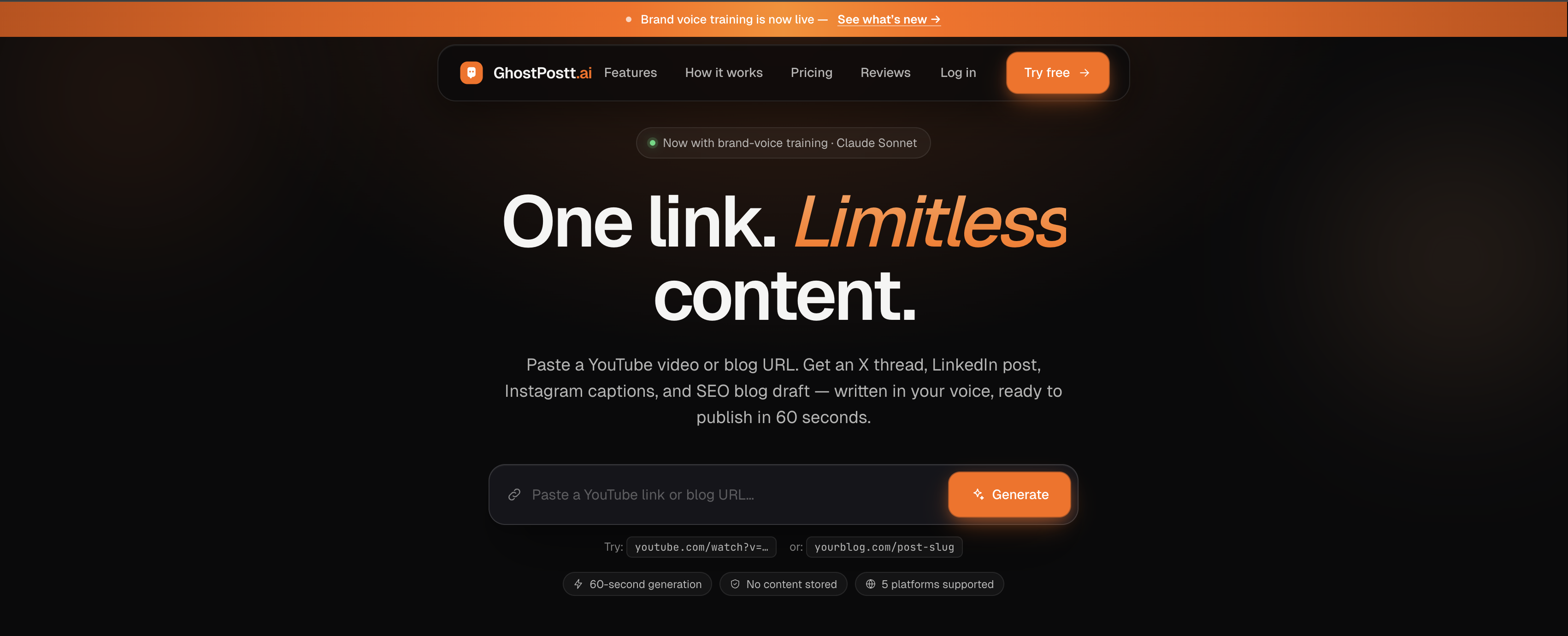
That's the problem GhostPostt AI solves. Paste your YouTube URL, and it extracts the key points, then generates platform-ready posts for X, LinkedIn, and Instagram — in your voice, not a generic AI voice.
The strategy above still requires your judgment. You decide what to post and when. But the writing part? That's already done.
Start with what you already have
You don't need a new idea. You need to look at your last five videos and ask: did I actually get everything out of those?
Pick one. Run it through the system above. See how much more mileage you get from content you already made.
That's the whole game.